Prototyping used to be an expensive and time-consuming process in engineering, but fortunately, recent technological developments in 3D printing have changed that. Although 3D printing technology has been around for more than 30 years, it’s only recently become an economic choice for mass production.
3D printing and rapid prototyping may seem like similar processes, but a few crucial differences exist between them. 3D printers manufacture items by turning digital 3D models into objects. Unlike subtractive processes like CNC, 3D printing builds objects by adding material from a print head, nozzle, and other methods, allowing to precisely control the number of resources spent on prototyping. To put it another way, 3D printers can create something out of nothing.
Rapid prototyping is also an additive process, but it uses special materials such as photopolymers, thermoplastics, and metals to fabricate objects much faster than traditional prototyping methods. There are four major types of rapid prototyping, which we discuss below.
3D prototypes allow manufacturers to test new ideas and gauge performance before sending parts to mass production. Prototyping offers the flexibility to create multiple models, allowing you to experiment with a number of different builds at once. Because 3D-printed prototypes work for both visual and functional testing, they’re wildly popular among manufacturers who are testing new ideas.
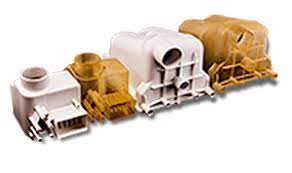
Understanding the different types of rapid prototyping will help you decide the best process for your needs. Manufacturers rely on four main types of prototyping:
Each of these processes uses a versatile range of materials. PolyJet and SLA processes operate with all kinds of photopolymers, FDM uses thermoplastics such as nylon and acrylonitrile styrene acrylate, and DMLS works with metals ranging from aluminum to titanium.
Advanced Prototype Molding will work with you to determine the best 3D-printed prototyping process for your needs. We’re experts in the industry, and we can’t wait to see what we’ll work on next.
For more information on 3D printing, rapid prototyping, and how you can use these processes to make the most of your product testing, contact us, and request a quote today.
You might think that the “selfie stick” was invented a few years ago, but it turns out the original was designed over 30 years ago. Like so many inventors, Hiroshi Ueda from Japan created a product to solve a problem.
While on vacation in Paris, he asked the youth to take a picture of his family at a famous monument, and the youth ran off with his camera instead. Ueda thought it would be great if he had a device he could attach to his camera to take his own pictures.
BBC News explains that his “telescopic extender stick” was an extendable stick with a tripod screw that was built for use with a new, small, camera. He added a mirror to the front of the camera so that photographers could frame the photo properly He was so convinced the selfie stick would be a hit, he applied for a US patent, and 2 years later it was approved.
The extender stick didn’t take off commercially, but Ueda continued to use it. His patent expired in 2003, about 4 years before the launch of the iPhone. Today selfie sticks are so prevalent that they are being banned in some public places for fear their use may result in property damage or injury.
Even still, Ueda has a good attitude about being ahead of the times. “My idea came too early, but that’s just one of those things,” he told the BBC. “We call it a 3 am invention…it arrived too early.”
A team of students in Singapore has crafted Asia’s first 3D printed “urban solar electric car prototype.”
The car took over a year to build and contains as many as 150 parts that were 3D printed. The goal of the car, called the NTU Venture (NV) 8, is to offer superior fuel efficiency standards while amplifying internal space for comfort.
Ilmi Bin Abdul Wahab, a fourth-year computer engineering student at Nanyang Technological University who led the development of NV8, said of the design, “Despite being an urban concept car, it is no slouch and can reach a top speed of 60 kilometers per hour while maintaining low-energy consumption.”
The car, mounted on a carbon fiber single-shell chassis, is slated to participate in the Shell Eco-marathon Asia race hosted in Manila, the Philippines later this month.
A bipartisan group of lawmakers introduced legislation that would provide federal funding to enhance education in the manufacturing space. The Manufacturing Universities Act of 2015 would create a program within the U.S. Commerce Department to select 25 “Manufacturing Universities.” Designated schools would receive $5 million per year for four years to meet specific goals related to engineering programs, building new partnerships with manufacturing firms, job training, and manufacturing entrepreneurship.
“As a small business owner who worked in manufacturing for over 35 years, I understand the difficulty in training and finding qualified manufacturing workers,” stated Rep. Chris Collins, R-New York. “To expand manufacturing in the United States, we need to have a workforce capable of filling these skilled jobs.”
“If we want businesses to expand and grow our economy, we need to make sure our workforce has the skills and training to match,” said Senator Gillibrand, D-New York. “No job should go unfilled and no company’s expansion should ever be inhibited because there aren’t enough trained workers. This legislation will equip more students with the advanced manufacturing skills and experience necessary to meet growing demand and ensure our manufacturing remains innovative and globally competitive.”
The director of the Commerce Department’s National Institute of Standards and Technology would lead the charge in overseeing the program. Sen. Chris Coons, D-Delaware, and Sen. Lindsay Graham, R-South Carolina, introduced similar legislation during the previous session of Congress, but the measure failed to advance through the Senate’s education committee.
It’s hard to believe that we’ve only been using plastics regularly for roughly 50 years. Marketed as “the material of the future,” plastics have become pervasive in our lives by adding convenience.
A new exhibit entitled “Plastics Unwrapped,” at the Burke Museum located on the University of Washington campus, explores the impact plastics have had on our lives and the world. Included in the tour are a life before plastics view, engineering and medical achievements, environmental impacts, and insight into global consumption.
The exhibit offers a thought-provoking historical context to the evolution of plastics. It reminds us of the perils of our waste and leaves us with a hopeful notion that our plastic-recycling possibilities are limitless.
Check out Michael Upchurch’s review in the Seattle Times.
Did you know that every year, Americans throw away enough paper and plastic cups, forks, and spoons to circle the equator 300 times?




ADVANCED PROTOTYPE MOLDING
1520 N Old Rand Road Wauconda, IL 60084
Tel: 847-202-4200
Fax: 847-202-4270
sales@advancedprototype.com

ADVANCED PROTOTYPE MOLDING
1520 N Old Rand Road Wauconda, IL 60084
Tel: 847-202-4200
Fax: 847-202-4270
sales@advancedprototype.com