When multiple parts are needed, urethane casting can help bridge the gap between prototyping and production. Advanced Prototype Molding provides urethane casting services for prototypes, pre-production parts, and select production applications. Cast urethane parts can be produced in a wide range of sizes, shapes, materials, colors, and finishes. Color can be matched using a Pantone number or a physical color chip.
Advanced can also meet specific part requirements with options for inserts, over-molding, copper shielding, molded-in color and texture, and painted custom colors and textures.
Typical uses for cast urethane parts include fit and function testing, product development, and marketing materials. In some production applications, urethanes can also be used for finished parts, particularly when thick walls or specific chemical resistance are required.
Urethane casting is a manufacturing method similar to injection molding in that polyurethane material is introduced into a mold to form the finished part. The difference is that urethane casting typically uses a softer silicone mold rather than the hard tooling associated with injection molding. This makes the process well suited to the small, multi-piece runs that often occur between prototyping and full production.
Advanced Prototype Molding offers urethane casting services for prototyping, pre-production, and production applications. Related capabilities include:
Urethane casting is a fast and flexible manufacturing method for creating prototypes and low-volume production parts. Silicone tooling can be customized to reproduce detailed part geometries, while a wide range of polyurethane materials and finishing options allows cast urethane parts to be produced according to specific application requirements.
Urethane casting uses a softer silicone mold compared with the harder machined molds commonly used for injection molding. Polyurethane materials can be selected to produce rigid, flexible, or rubber-like parts depending on the desired properties.
The process is well suited to complex parts, components, and products because detailed silicone molds can reproduce intricate design features. This flexibility makes urethane casting useful at different stages of product development, from early prototypes and fit and function testing to pre-production and certain production applications.
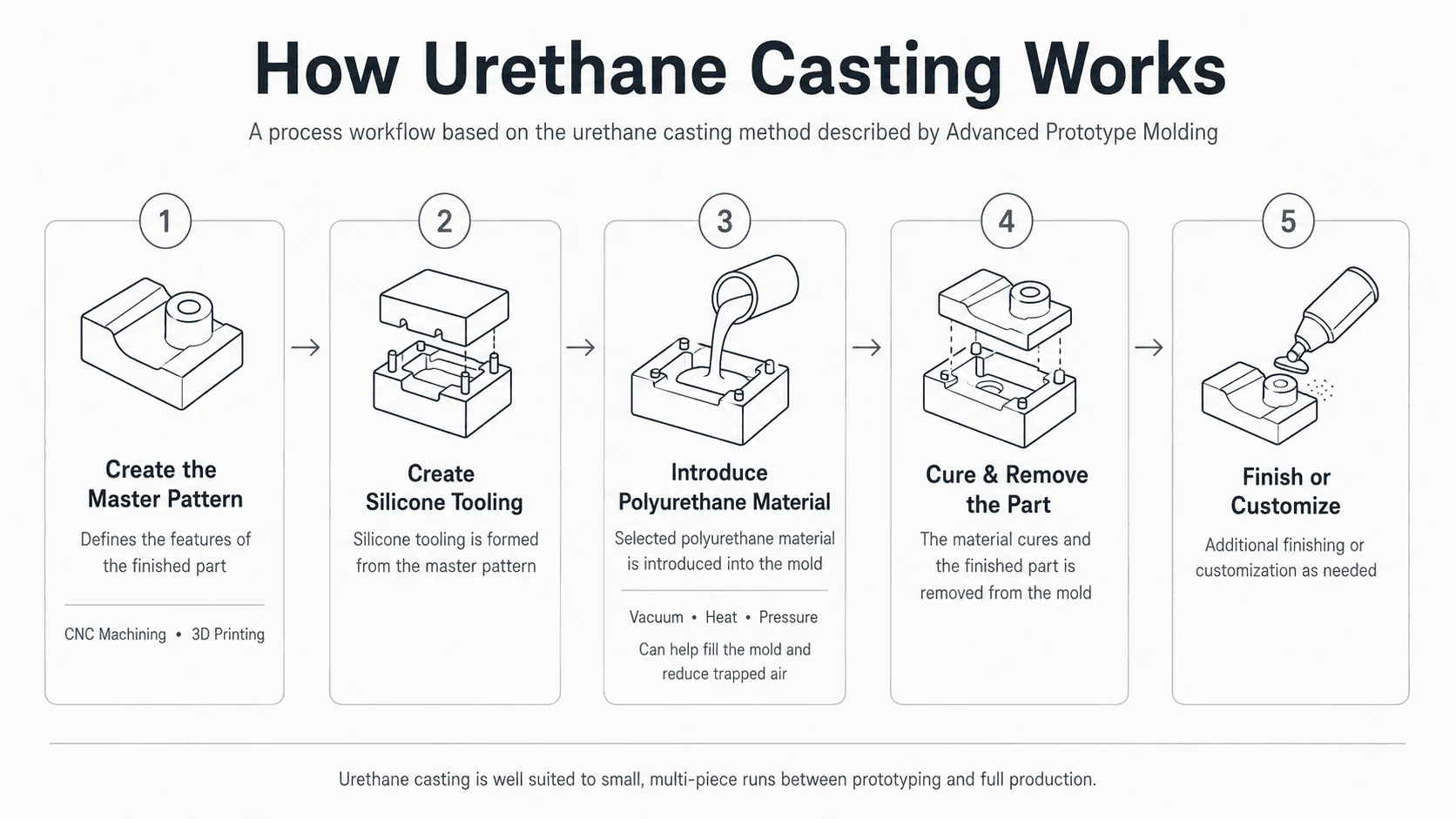
Urethane casting starts with the creation of a master pattern, which is a three-dimensional representation of the final product. The master pattern defines the features of the finished part and is used to create the silicone tooling.
Master patterns can be produced using several methods. Designers can create a CAD or CAM file and use CNC machining to produce the pattern, or the master can be 3D printed.
Once the silicone tooling is prepared, the selected polyurethane material is introduced into the mold. Vacuum, heat, and pressure can be used during processing to help the material completely fill the mold and reduce trapped air. After the material cures, the finished cast urethane parts are removed from the mold and can receive additional finishing or customization as needed.
There are many advantages to using urethane casting over other molding or manufacturing processes. These include:
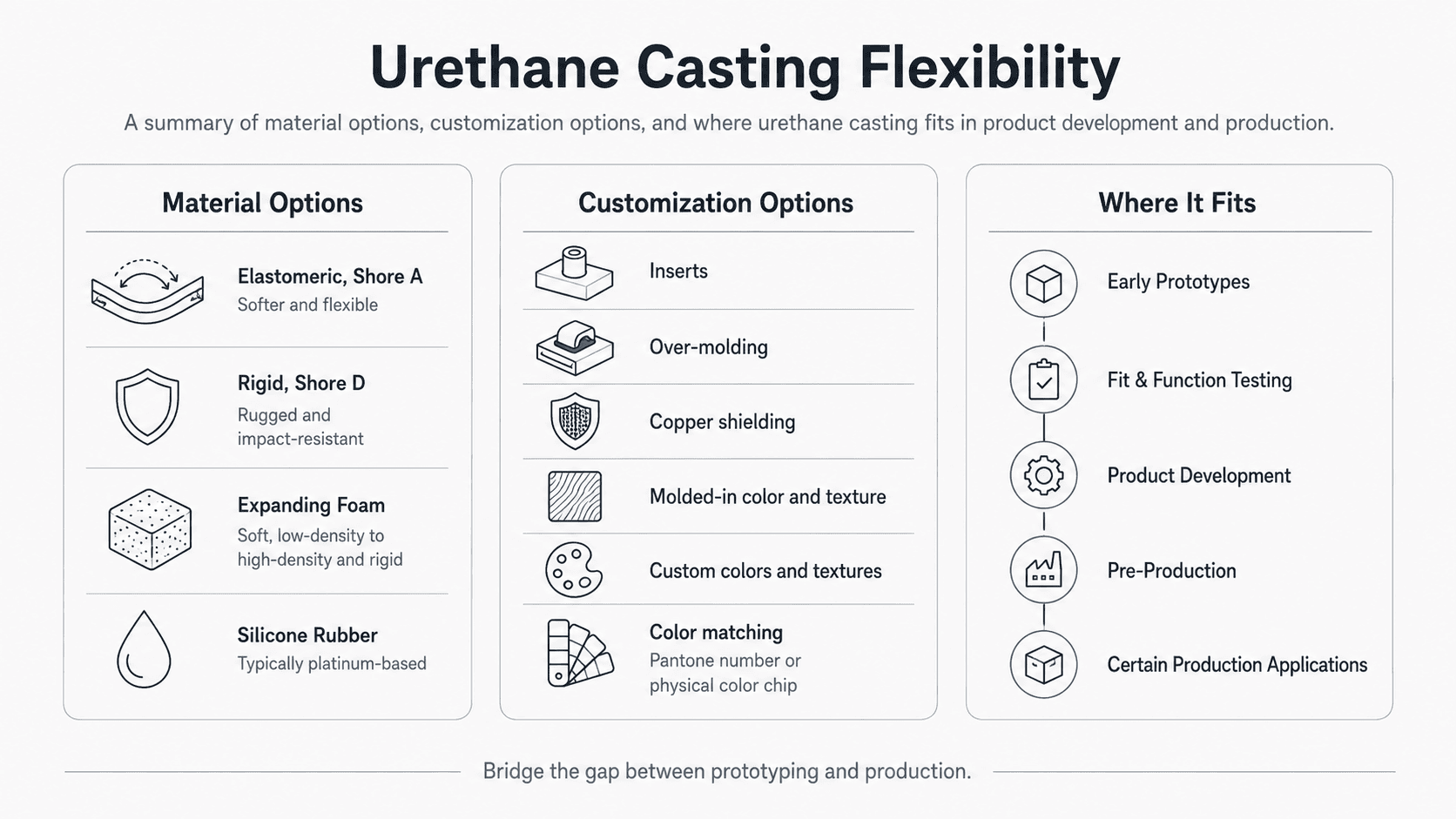
Material selection is an important part of the urethane casting process. Advanced Prototype Molding can help identify polyurethane materials based on the physical properties and performance requirements of the finished part.
A variety of materials and additives can be used to achieve different characteristics, colors, finishes, and textures.
Four common material categories include:
Material and additive combinations can also be selected to meet specific industry requirements. Depending on the material and application, options are available for requirements such as UL 94-VO and FAR 25.853 flammability ratings, as well as cleanliness requirements associated with certain medical and pharmaceutical applications.
Urethane casting services are used across a range of industries because they can produce functional parts with different material properties and appearances without the tooling investment associated with some conventional production methods.
Industries that use urethane casting include:
Cast urethane parts can be used for a variety of applications, including:
Below is a newly added section.
Urethane casting can be customized to meet functional, appearance, and assembly requirements. Advanced Prototype Molding can provide options such as:
These options allow prototype and production parts to more closely represent the intended appearance and functionality of the final product.
Advanced Prototype Molding provides urethane casting services for prototypes, pre-production, and production applications. Our team can assist with material selection and provide customized cast urethane parts with inserts, over-molding, copper shielding, colors, textures, and additional finishes.
For projects that require silicone tooling as part of the urethane casting process, Advanced also provides RTV molding services.
Advanced Prototype Molding also offers a variety of other manufacturing services to support projects from initial product development through production.
At Advanced Prototype Molding, our processes are designed to create accurate and affordable parts and products. Contact us or Request a Quote today with the details of your project.

ADVANCED PROTOTYPE MOLDING
1520 N Old Rand Road Wauconda, IL 60084
Tel: 847-202-4200
Fax: 847-202-4270
sales@advancedprototype.com
ADVANCED PROTOTYPE MOLDING
1520 N Old Rand Road Wauconda, IL 60084
Tel: 847-202-4200
Fax: 847-202-4270
sales@advancedprototype.com